

The likelihood of a kidney stone passing naturally depends largely on its size. Stones that measure less than 4 mm have the highest chance of passing without surgical treatment.
What Are Kidney Stones?
Kidney stones are hard, pebble-like deposits that form inside the kidneys when certain substances in the urine become highly concentrated. Normally, urine contains dissolved minerals and salts that the body flushes out. However, when there is too little fluid or an excess of stone-forming substances, crystals begin to develop. Over time, these crystals stick together and grow into solid stones that can vary in size from a tiny grain of sand to a larger, painful mass.
Causes and Risk Factors of Kidney Stones
Kidney stones form due to a combination of factors such as dehydration, dietary habits, certain medical conditions, and genetic predisposition. When you do not drink enough water, urine becomes concentrated, allowing minerals like calcium, oxalate, and uric acid to bind together. Conditions like obesity, recurrent urinary tract infections, and metabolic disorders can also increase the risk. In some cases, stones develop because the body produces excessive amounts of specific minerals.
Types of Kidney Stones
There are several common types of kidney stones. Calcium stones are the most frequent and usually contain calcium oxalate or calcium phosphate. Uric acid stones form when urine is too acidic. Struvite stones are often linked to urinary tract infections, and cystine stones are rare, caused by a hereditary disorder affecting amino acid processing.
Kidney Stone Size Chart (In Millimeters)
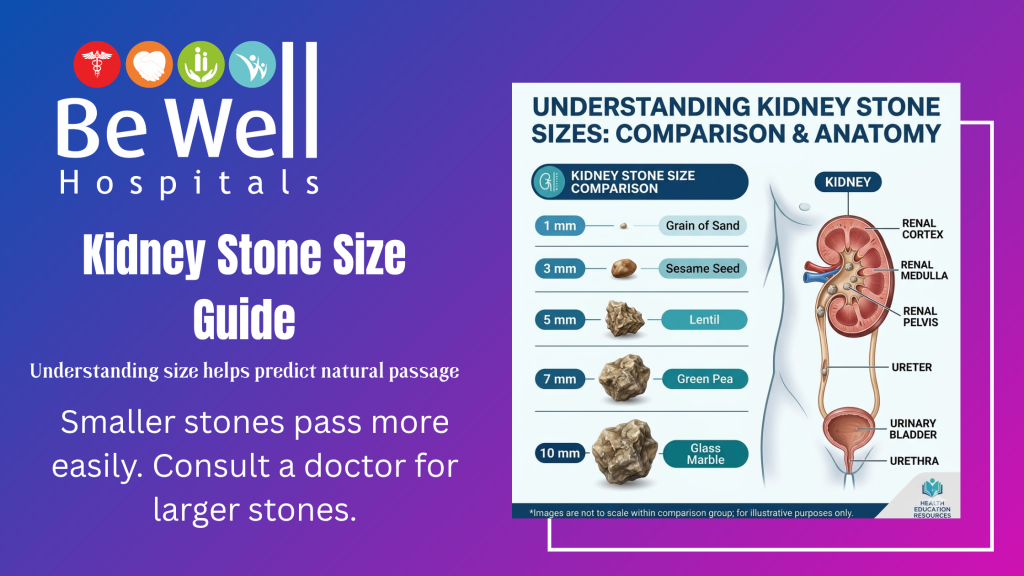
Kidney stone size is usually measured in millimeters (mm), a small unit used in medical imaging such as ultrasound or CT scans. One millimeter is one-thousandth of a meter, and even a 1–2 mm difference can significantly affect symptoms and treatment decisions. Doctors rely on this measurement to estimate whether a stone is likely to pass naturally or require medical intervention.
To better understand stone size, compare it with everyday objects. A 1–2 mm stone is about the size of a grain of sand and may pass without causing major discomfort. A 3–4 mm stone is similar to a sesame seed. Stones measuring 5–6 mm are closer to a lentil, while an 8 mm stone can resemble a pea. Anything 10 mm or larger is roughly the size of a marble and is much less likely to pass on its own.
Size matters because it directly influences the chances of natural passage and the intensity of symptoms. Smaller stones generally pass more easily through the urinary tract, while larger stones are more likely to get stuck, causing severe pain, blockage, or infection. Treatment decisions are largely guided by stone size.
Stone Size vs. Chances of Passing Naturally
The likelihood of a kidney stone passing naturally depends largely on its size. Stones that measure less than 4 mm have the highest chance of passing without surgical treatment. In many cases, these tiny stones move through the urinary tract within a few weeks, especially with adequate hydration and pain management. Although they can still cause discomfort, medical intervention is usually not required unless complications arise.
Stones that are 4–6 mm fall into a moderate category. Around half of these stones may pass on their own, but the process can be more painful and prolonged. Doctors may prescribe medications to relax the ureter and improve the chances of passage. For stones measuring 6–8 mm, the likelihood of natural passage decreases significantly. These stones often get lodged in the ureter, increasing the risk of severe pain, obstruction, or infection.
Stones larger than 8 mm rarely pass without medical assistance. At this size, the stone is more likely to block urine flow and cause persistent symptoms. Procedures such as shock wave therapy or minimally invasive removal are commonly recommended. Early medical evaluation is important to prevent kidney damage and other complications.
How Long Does It Take for a Kidney Stone to Pass?
The time it takes for a kidney stone to pass varies mainly based on its size and location. Small stones under 4 mm may pass within a few days to two weeks. Stones measuring 4–6 mm can take up to two to three weeks, and sometimes longer. Larger stones above 6 mm may take several weeks and are less likely to pass without medical help. The stone’s position in the urinary tract also matters—stones closer to the bladder generally pass more quickly than those still in the kidney.
Several factors influence passing time. Staying well hydrated increases urine flow and may help move the stone along. The width of the ureter, muscle spasms, and any existing inflammation can affect how smoothly the stone travels. Medications known as medical expulsive therapy may relax the ureter and shorten the passage time. Individual pain tolerance and overall kidney health also play a role in how the experience unfolds.
Waiting is usually considered safe when the stone is small, pain is manageable, and there are no signs of infection or blockage. However, persistent severe pain, fever, vomiting, or reduced urine output requires immediate medical attention.
Symptoms Based on Stone Size and Location
Symptoms of kidney stones can vary depending on both their size and location within the urinary tract. Interestingly, pain intensity does not always directly correlate with size. Even a small stone can cause severe pain if it moves into the ureter and blocks urine flow. Larger stones may remain silent while inside the kidney but trigger intense, cramping pain—often called renal colic—once they begin to travel. Pain is typically felt in the lower back or side and may radiate to the lower abdomen or groin.
Blood in the urine is another common symptom and can occur regardless of stone size. As the stone moves, it can irritate and scratch the delicate lining of the urinary tract, leading to pink, red, or brown-colored urine. Some patients may not visibly notice blood, but it can still be detected through laboratory tests. The presence of blood often indicates irritation rather than severe damage, but it should always be medically evaluated.
Nausea and vomiting frequently accompany intense pain due to shared nerve pathways between the kidneys and digestive system. Urinary blockage signs—such as difficulty urinating, reduced urine output, or a persistent urge to urinate—may indicate obstruction. Fever and chills alongside these symptoms can signal infection and require urgent care.
When Is Medical Treatment Needed?
Medical treatment for kidney stones is needed when the stone is too large to pass naturally, causes persistent severe pain, leads to infection, or blocks urine flow. Stones larger than 6–8 mm are less likely to pass on their own and may require intervention. Immediate treatment is also necessary if there is fever, kidney function impairment, or repeated vomiting. The choice of procedure depends on the stone’s size, location, and the patient’s overall health.
One common non-invasive option is Shock Wave Lithotripsy (SWL). In this procedure, high-energy sound waves are directed at the stone from outside the body to break it into smaller fragments that can pass naturally. For stones located in the ureter or those not suitable for SWL, Ureteroscopy (URS) is often recommended. This involves passing a thin scope through the urinary tract to locate and break the stone using laser energy.
For very large stones, typically over 10–20 mm, Percutaneous Nephrolithotomy (PCNL) may be advised. This minimally invasive surgery involves making a small incision in the back to remove the stone directly from the kidney. In rare cases, traditional surgery may be required if other treatments are unsuccessful.
Knowing When to Wait and When to Act
Understanding kidney stone size plays a crucial role in deciding whether a stone will pass naturally or require medical treatment. While smaller stones often pass with hydration and supportive care, larger stones may need timely intervention to prevent complications. Paying attention to symptoms such as severe pain, fever, or difficulty urinating is equally important. Early evaluation and appropriate management can protect kidney function and reduce discomfort. If you suspect a kidney stone, consulting a doctor ensures the safest and most effective treatment approach tailored to your condition.